Blog

Kindred Souls

by Audrey Corby Braden ‘63

I felt something as soon as I walked into her living room. As a nurse I have made many homecare visits to the elderly and infirm in the area, but this visit was special. I was on a routine visit in Xenia, Ohio and I felt an immediate kinship with the lovely lady of the house. I commented on the array of crosses and crucifixes adorning her living room walls and mentioned that I had gone to a catholic school run by the Ursuline Sisters of Brown County. She must have been a godsend because it turns out that my patient, Ms. Margaret Shelley, had graduated from Brown County in 1920.

I had a million questions for Miss Shelley. What was the school like in those days? How was it different than when I went there 40 years later? I was amazed at the clarity and detail of Ms. Shelley’s memories 74 years after she graduated. She remembers names. Mother Angela was Mother Superior, Sr. Mechtilde was Principal and taught French and history, Sr. Monica, author of The Cross in the Wilderness, taught American and European history, Sr. Mary Baptist taught Saturday morning sewing classes and accompanied the girls every evening as they walked down the lane and around the pond praying the rosary.

She remembers the rituals. Every morning the girls ate warm cornbread with syrup for breakfast. Students were encouraged to attend Mass every morning, but it was required on Sundays. Every morning as “roll” was called, the girls would answer “Yes Sister” if they had some kind of penance to do or “No Sister” if they were “home free”. Thursday penance usually required an essay on the misdeed and sometimes a verbal confession of the misdeed in front of the entire class. Boarding students went home only on Christmas and Easter holiday breaks because travel was long and difficult as many of the girls lived out of state. Students attended all of the Professions, but Miss Shelley particularly remembers attending the Profession of Sr. Mary Ursula, a little Irish nun who was young and always happy, and who shared many stories of Ireland with the girls.

Miss Shelly graduated with five other girls on the occasion of Brown County Ursulines’ 75th Anniversary in 1920. She attended Sacred Heart College in Cincinnati, OH for one year, but transferred to Antioch College in Yellow Springs, Ohio and graduated with her teaching certificate in 1924. She taught for many years at the Blessed Sacrament Convent in New Orleans, Louisiana and Chicago, Illinois. In the 1950s she returned to Xenia to care for her mother in the home her grandfather built in 1902. It was there, 74 years later as the Brown County Ursulines prepared to celebrate their 150th Anniversary that I happened upon this wonderful lady. I asked her if she would like to visit BCU again and her reply was “I want to remember Brown County the way it was.”

kindred1
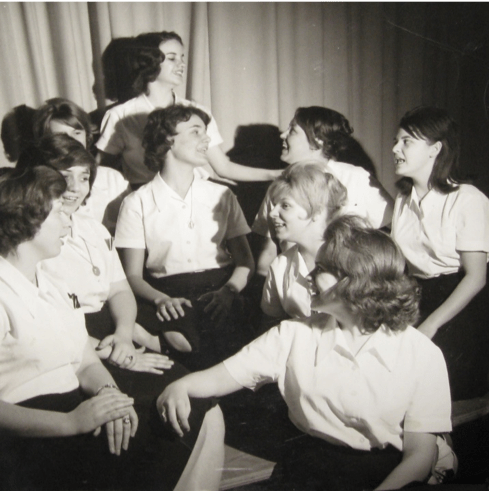
Top Center: Dolly Fisher, in front of her is Laurel Hafertepen, Jill Woeber Sooy, Audrey Corby Braden, Carol Tipton, Regina Reddick Baynard,
Right Front: Linda Quallen and Susan Cleary Dunn
kindred2
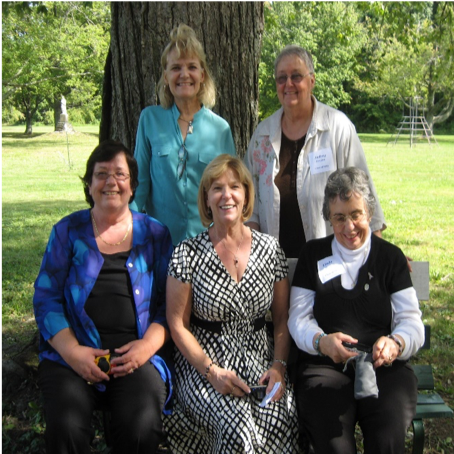
Standing from left: Laurel Hafertepen, Audrey Corby Braden
Seated from left: Gail Glassmeyer Napier, Jill Woeber Sooy, Linda Hocke


Reflections on the past 50 years

by Linda Patterson ‘61

reflections

I have held a prestigious title for the past 21 years; I am known as Granny Bubbles. When my granddaughter was a toddler, she entered our front door chanting “Bubbles, Granny, Granny, bubbles,” until she spied her bubble jar. Being at Brown County for three years, I naturally thought about becoming a nun. However, it crossed my mind that why would I want to be stuck with the everyday habits of praying, cooking, praying, washing clothes, praying, dusting…

I wound up doing all that, plus with three children I was also scrounging for their shoes trying to make it to Mass on time. Me, losing my religion before I got to Mass, while three children were yelling from the back seat of the car, “Mom, she looked at me!” “Mom, he touched me!” “Mom, make him stop!” My life has been far from normal; many times I felt I should have been a nun.

My real accomplishments, minus 1, are here with me today – three children and five grandchildren. They possess the best of me.

reflections2

A Night Out at BCU

by Julie Powers Lopez ‘69

Most of the time, I have memories of all the girls in our class.  Some memories stand out very clearly, such as the night of our senior year, when we sat huddled together in Chatfield Hall, while our favorite neighborhood pervert tried his best to get into the building.

I vividly remember the night that Sister Timothy took us out for a scary night of fun on the grounds. Each girl chose something to use as a weapon. All I could find was Sister Mary Anthony’s broom.  Sister Timothy assured me that Sister Mary Anthony would not mind if I borrowed it.

As I remember it, only Sister Timothy had a flash light. The rest of us crept terrified behind her all the way from the basement door to the main gates.  The wind rose, making the old chestnut trees sway in the rising winds.  On the way back down the drive, as we approached the area of the old Indian cemetery, I thought I saw a huge spider creeping across the pavement in our direction. I bravely said that I would kill it. I took a mighty swing at the arachnid with Sister Mary Anthony’s little broom.  I brought the bristles down hard on the spider, and heard a horrible cracking sound.  I couldn’t tell if the spider made the noise, or what. I raised the broom to see if there was anything left of the giant spider, when to my horrified eyes, I beheld, Sister Mary Anthony’s broken broom. Everybody broke out laughing except me. Sister and the girls took off down the road, laughing.  I could see only Sister Mary Anthony shaking her aged fist at me and saying she was going to write my mother that I was probably going to go to hell.

Sister Timothy told us a wonderful scary story while we sat around a cold campfire.  Everyone’s mind was on the story, except mine. Sister Mary Anthony was very real and frightening.  A ghost was infinitely less terrifying than Sister Mary Anthony.  She had chased me up the front and back stairs on more than one occasion, just for tracking in some dirt.  This was far more serious.

I had just enough time to think my response to the broken broom through.  I told Sister Timothy that I was really scared of the repercussions for breaking the broom. I had decided to place the broken broom in her cupboard, along with a note. I would explain my actions, and told her that I would buy her a new broom on our next weekend home.

I slept very poorly that night.  All the next day, I kept looking around corners as I approached corridors, to make sure that Sister Mary Anthony was not cleaning in that area. By 4 p.m., I thought that I was home free. I was walking from the Second Department Home Room toward the stairs when I felt a hand on my shoulder.  I froze in fear.

I slowly turned around to see Sister Mary Anthony standing behind me.  She had her arms folded across her flat bosom. She fixed me with a stare.  I could not have run away. She just stared at me for a moment, then asked if I was Julie Powers. I admitted that I was. I was cringing inside, terrified at what she would say. I never expected her to say the next words. “You never should have taken my broom.  You’re right about that.  But you were very responsible to own up to the misdeed.  Not one in a hundred girls would have done that. If you can find a small broom, fine.  But don’t worry about it. I will also look for a replacement.” Then she turned a walked away. I was rooted to the spot. By the time I reached the dorm, I was laughing rather hysterically. Sharon Bruce asked me what was going on. When I told her, she could hardly believe it.

I was able to find a small toy broom, with a tiny dust pan.  I was very happy to return to Brown County with the promised bounty. Sister Mary Anthony was delighted with her new broom and dust pan.  They fit her small frame very well.  She used them up until right before her death.

Fond Memories and Lifelong Bonds

by Cheryl Reindl-Johnson ’78
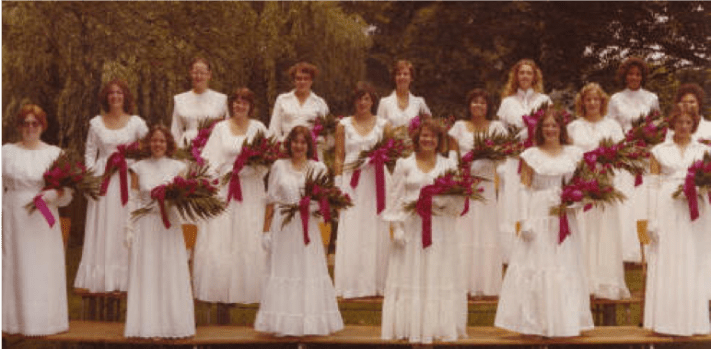
fondmemories1Front: Cathy Cassner, Mary Grace Bernardin, Lisa Dowd, Erin Hicks, Heather Paschall, Kimberly Reindl
2nd Row: Catherine LaRuffa, Brenda Huesman, Cheryl Reindl, Sylvia Alonzo, Ann Cooley, Sylvia Valiente
Back Row: Virginia Starzl, Stephanie Emery, Astri Bush, Bonnie Bates, Natalie Jones
fondmemories2
Front: Cathy Cassner, Cinder Heitzman Beuerlein, Stephanie Emery Bull
2nd Row: Brenda Huesman Pierre, Bonnie Bates Roberts, Natalie Jones, Catherine LaRuffa, Kimberly Reindl McFarland
Back Row: Cheryl Reindl-Johnson, Astri Bush Tadlock


I remember how upset I was when my father informed my sister Kim and me that we would be going to an all-girl, Catholic high school. Although I had attended Catholic school for most of my life, it had not been all girls and it was not located way out in the “boonies.” It was particularly disturbing to find out that many of the girls lived on campus—that brought about visions of quiet “Nun-patrolled” hallways, girls in starched, buttoned-up uniforms, and daily processionals to Mass so that these Nuns could try to convince us to join the Convent. What I found instead was a beautiful campus full of history that was enjoyed (sometimes loudly) by students and Sisters. We did attend Mass regularly, but there were not fire and brimstone sermons, but rather uplifting and encouraging sermons celebrated in song by a beautiful chorus of voices accompanied by various students and teachers on guitar.

Who would have thought that the little school out “in the sticks” with fewer than 100 students, would be so rich in diversity, culture, and empowerment. I think I spent much of the first week with my mouth hanging open – trying to learn where everything was located. Instead of room numbers there were locations like Sunnyside, Playhall, Keller, and Cherry Loop. Within a week I had it figured out and had carefully mapped my way from the “butt bench” for a cigarette to each of my classes. I had to be careful of my language and behavior outside of class though, because I was not used to Nuns out of their habits, wearing “normal” clothes or even blue jeans and who could then sneak up on me! I was amazed that between classes students were free to roam around campus, lie across the various couches and seats in Sunnyside and read, chat, or listen to records.

The Ursuline Sisters built a school that nurtured and empowered girls and helped them grow into women. The curriculum was rigorous and challenging, and peppered with classes that helped us grow culturally, politically, and socially. We were taken out into the community to interact with people we would otherwise probably never have acknowledged – we took food to families living in shacks in Appalachia and we sang Christmas carols in nursing homes. The six-week mini- courses they offered one year allowed us to explore many different subjects, and in some cases allowed students to teach. I remember learning to speak a little German in a class taught by classmate Sylvia Alonzo, I made a shirt for my boyfriend in a six-week sewing class, and I learned horseback riding from two younger students.

During my senior year at BCU, juniors and seniors were allowed to take college classes at Chatfield College if they had earned a certain grade point average and could fit it into their schedules. I took beginning Italian from Sr. Marie DiMercurio who was assisted by Joan LaRuffa. I got through it and I learned a lot once I got past my initial concern when attendance was called the first day and I realized that I might be at a bit of a disadvantage. The four students in this class were: Catarina LaRuffa, Stefana LaRuffa, Innuccia Milleti, and me, Cheryl Reindl!

Those kinds of opportunities were enriching, but it was really my classmates that made my experience at Brown County life altering. The class of 1978 formed a bond immediately. Although we were all very different – rich and poor, local and international, brains, partiers and jocks – sometimes the same person having multiple personas—we accepted each other. Instead of being put off by our differences, we explored them. Many of us learned how to swear perfectly in Spanish from our classmates from Mexico and South America. Wealthy classmates with lots of clothes lent them out to those of us without as much (although if you looked closely you might find that underneath the trendy designer pants that I borrowed from Sylvia, my knee socks were held up with rubber bands). Natalie Jones, our only black classmate, who was beautiful, intelligent, and articulate, defied the stereotype we saw on TV. She was also very proud of her ethnicity and she educated us about black culture and society.

We enjoyed hearing Cathy Cassner’s heavy Kentucky-accented pronunciation of “dialogues” in Spanish class. We equally enjoyed Gloria Ortiz’s heavily accented English exclamation that “somebody sheeted! somebody sheeted!” during the count of 21 votes (from a class of 20) for freshman class president. There was camaraderie and loyalty that grew over our four years and that has lasted for 30 years.

It is amazing how much people change, and how much they stay the same. We watched Cathy Cassner grow from an awkward country girl from Kentucky into a successful businesswoman and philanthropist. Astri Bush Vaske grew from a major party girl into the director of a large Montessori school in Alabama. Rini LaRuffa was always driven—serving as student body president, musician and vocalist, actor, and part-time college student. It is not surprising that she is now a successful family physician and a community leader. Sylvia Alonzo Rineair lived her high school dream: became a registered nurse, married her high school sweetheart, and had her desired two children who have grown into fine young men. Lisa Dowd Lee, who came to Brown County as a naive young girl, is now employed in a medical office and the mother of a wonderful 26 year-old son named Michael and wife to Bill.

Brenda Huesman Pierre, once she stopped crying herself to sleep every night in the freshman dorm, became the class mother and nurturer. She is now an Officer in a federal bank and unofficial mother to all those around her. Bonnie Bates Roberts, local girl who grew up on a farm, is an insurance executive who lives on the East Coast. Cinder Heitzman Beuerlein is still the hilarious, happy “instigator” she was in high school, but she also owns a successful business and raised a track star and artist. A review of Stephanie Emery Bull’s wardrobe and hair styles throughout our four years of high school may have foretold that she would grow up to be an artist, but she is also married and has raised two children (one who spent 6 months in Africa on a mission trip). And my sister, Kim Reindl McFarland who came to BCU with me in 1975, is a successful cosmetologist, wife, and mother of two.

My education and experiences at BCU was life-changing, and instilled in me a strong sense of acceptance and empowerment. This empowerment has helped me often in the years since I graduated. I took risks and tried things that I might have otherwise been afraid to try. I met many fascinating people that I might never have approached or to whom I might not have responded. I faced exclusion with a determination to break down barriers I might otherwise have assumed were unbreakable. And, I have maintained friendships for more than 30 years with a group of very diverse and interesting women who have enriched my life immeasurably.